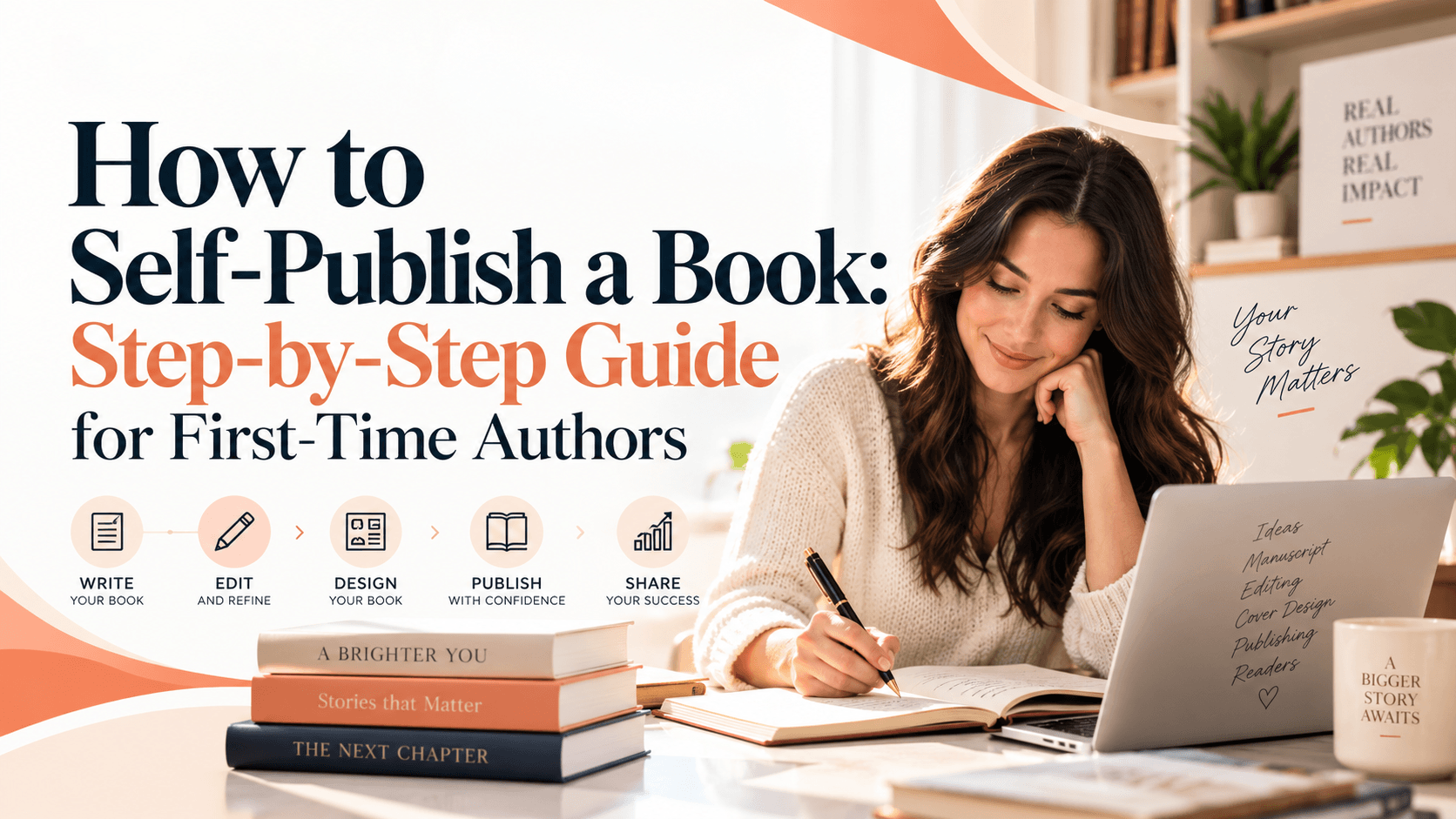
How to Self Publish a Book Step by Step Guide for First Time Authors
To start writing or completing a book is a huge creative accomplishment, finishing a manuscript is much more so. Theses’ been a difference between completing the manuscript or just writing it down. The actual challenge isn't how to how to self-publish a book on your own; the real question is how to become the publisher, the one who decides on the manuscript's editing, legal, production, distribution, and launching decisions. Although authors may bring in specialists to help with these responsibilities, ultimately, the publisher is responsible for making all of the final decisions.
There are certain tweaks and tips that an Author must now before publishing a book. Since writing a book does not occur in a linear fashion, the process might seem confusing to first-time writers. Once the number of pages and trim size are specified, the cover may be finalised. The text, approvals, and production timeline should all be solid before a release date is announced. An uploaded file does not always constitute a professional publishing output, and distribution is distinct from marketing. Choosing the correct sequence of actions is the surest path forward.
Before you begin understand the job you are taking on
Know what you're getting into when you start publishing yourself; self-publishing gives you control but not shortcuts. Everything from the book's cover design to its publication date, distribution channels, and required expert assistance is up to you. Quality and budget management are your responsibilities in return. Anyone may legally publish their work via paid aided publishing, self-publishing, or traditional publishing; the real distinction is in who foots the bill, manages the files and retailer accounts, and owns the necessary rights.
Route | Control | Main responsibility |
Traditional publishing | The publisher directs production within the contract. | Seeking representation or acquisition and accepting a longer, selective process. |
Independent self-publishing | The author controls the files, accounts, schedule, and pricing. | Managing or hiring every editorial, production, and launch stage. |
Assisted publishing | Control depends on the written service agreement. | Reviewing scope, rights, file ownership, retailer accounts, and exit terms before paying. |
1. Define the reader and the purpose of the book
A one-page publication brief should be written before any financial investments are made in editing, printing, or marketing. Book details should include target audience, promises made to that audience, genre, anticipated publication forms, a reasonable release date, and desired result.
Although they may be equally well-written, the covers, pricing points, formats, distribution options, and launch strategies for a family memoir, a business book meant to generate speaking engagements, a children's book meant for schools, and a commercial novel couldn't be more different. For all subsequent decisions, the reader serves as the point of reference.
• Take note of the target demographic, publishing style, cover language, pricing, and retailer information of at least two and preferably three similar publications.
• In the first half of the year, prioritise one result above the other. This may be sales, credibility, speaking opportunities, reader reviews, bulk orders, or community impact.
• A platform is not the place to start. Consider the trip you want your readers to take before you write a word.
2. Stabilize the manuscript before you format it
Mistaking a finished draft for a book suitable for publication is a typical rookie mistake. Once a book's primary structural work is finished—ensuring that chapters are properly organised, that the tale or argument has a clear through-line, that factual information is verified, and that the author is no longer making significant changes on a weekly basis—the text becomes stable.
To find issues and combine comments from experts in the field, use beta readers or critique partners. You shouldn't create a fresh edit for each remark. Try to spot recurring red flags like a sluggish beginning, vague recommendations, a missing reference, a character gap, or a title that doesn't live up to its promise.
When formatting is done too early, design expenditures are squandered and additional problems are introduced during late rewrites. Prior to engaging professional editors, it is recommended to maintain a master text and create a dated archive.
3. Build an editorial sequence rather than buying one vague editing service
You can't do it all with editing. Issues with organization, flow, tempo, voice, and the overall reading experience are all part of developmental editing. Grammar, style, citations, consistency, and language are all checked during copyediting. After the layout of the inside pages is complete, proofreading is the last step in checking for errors. A book that still requires structural work cannot be effectively repaired by a proofreader.
Enquire about the editor's editing level, the nature of the deliverable, the number of pages or words included, the process for revisions, and if the advertised fee includes a sample edit from each. The writer and the editor are both shielded by a well-defined scope.
When a manuscript is in its early stages of development, development work is often the most worthwhile investment.
• Copyediting need to follow major modifications, not before them.
• Check for any remaining mistakes in the final PDF or print proof; formatting and last-minute edits might introduce new mistakes.
4. Keep the document secure and remove any content from other sources
Although copyright protects written works after they are physically bound, this in no way grants the author authority to repurpose another person's copyrighted words, pictures, music, drawings, or significant quotes. Make sure to start a permissions record as soon as possible if your book will be using any third-party content, such as interviews, client tales, images, or artwork.
An ISBN and copyright registration address distinct issues. The official record of an artwork is what registration is all about. Each edition or format is uniquely identified in the marketplace by its ISBN. Learn which formats need unique IDs, who will be listed as publisher (if any), and if the ISBN is yours if you choose to manage your own imprint details. Do not depend on a generic web response for concerns like contracts, co-author ownership, fair use, taxes, or trademarks; instead, seek expert professional assistance.
5. Design a market-appropriate cover and inside
Cover art serves as a category indication in addition to being an artistic creation. By looking at the cover, readers may tell whether the book is a thriller, a biography, a romance, a business handbook, or even a children's book. Before briefing a designer, read novels that are similar. Please elaborate on the following: the intended audience, the promise, the tone, the essential features, and the covers you like or dislike.
Equal attention is required for interior formatting. Pick a font and size for the trim that works with the genre and length of the book. Before sending to print, double-check all of the following: chapter beginnings, running heads, page numbers, front and back matter, picture quality, widows and orphans, and spine. Make sure to test the eBook's readability, picture behaviour, chapter navigation, and contents links on many devices. Get a hard copy of the book once it's going to be published.
6. Get the book's metadata ready before you send any files.
All parties involved in the book's lifecycle—from consumers to libraries to search engines—use metadata to better comprehend it. Included are the following: title, subtitle, identifier, format, price, author's biography, description, keywords, categories, and publishing date. An excellent book may go unnoticed due to inadequate metadata.
Rather of writing it as a resume or narrative synopsis, approach the book description as a sales page aimed at readers. Issue, promise, or emotional hook in the beginning; value or stakes made evident; and book-fitting invitation at the conclusion. Ensure that all fields are filled out consistently with the author's website, store sites, press materials, and social profiles with respect to spelling and language.
7. Consider your target demographic when making format and distribution decisions.
There is a world of difference between paperback, hardback, eBook, and audiobook in terms of price, file needs, and potential sales. You should start by writing in the forms that your target audience is most familiar with. There may be a need for both paper and eBook versions of a concise business handbook. Specifying a premium colour print run might be necessary for an illustrated piece. A small supply of author copies can be necessary for a work that has great direct-event potential.
When a book is available for purchase via a sales channel, we say that it is distributed. Shelf space, reviews, sales, or advertising are all things it does not guarantee. Every channel has its own set of advantages and disadvantages in terms of margin, discounts, returns, fulfilment, customer care, and print-on-demand providers, distributors, direct sales, and retailer accounts. On day one, don't chase every available source; instead, choose a concentrated blend.
8. After you've mastered unit economics, step eight is to set the price.
Consider the book's function in your larger author company, the reader's market, similar books, printing cost, retailer discount, and royalties when setting the price. The production cost of print-on-demand books changes depending on factors such as marketplace, trim size, page count, ink, and paper. Issues will arise in the future as a result of an enticing pricing that does not allow for any profit margin after printing or wholesale reductions.
Get a feel for the royalty calculators used by each site before you settle on a listing price. When planning for direct sales, don't forget to include in time for processing payments, packing, fulfilment, event fees, and sales tax records. Make use of a basic spreadsheet to track the revenue generated by each channel for a single sale.
9. Construct the launch in advance of the publishing date
A book's launch doesn't start when it goes on sale; it starts when it's becoming real. Get the author's profile, cover art, store description, sample chapter, media kit, email announcement, social media materials, and one concise purchase route ready. Readers, libraries, podcasts, professional groups, schools, organisations, and former customers are all examples of communities and individuals that might be considered relevant to the subject or genre.
Consistent exposure, rather than a sudden splash of colour, is the aim. Spread the word over the course of many weeks about the book's goal, helpful passages, the creative process, and topics that will resonate with readers. Make sure you ask for feedback in an ethical and rule-compliant manner. Whether it's sales, email subscribers, speaking requests, mass enquiries, or reader comments, keep track of the metric that's related to your initial aim.
10. Release with care and maintain the project's viability thereafter.
Make sure the title and author's names are spelt correctly before hitting publish. Then double-check the subtitle, price, territorial settings, description, cover, inside file, keywords, categories, page count, and preview. Lastly, press post. Later on, check out the mobile and desktop versions of the live listing. Before you sell print copies, be sure to check the first one that is sent. Think like a consumer.
You shouldn't leave the book hanging after launch. Be sure to save the original source files, update the author website, solicit enquiries from readers, monitor reviews, make any necessary revisions to the description, and keep an eye on pertinent events. Data is the first release. It lets you know who reads your work, what messages resonate, and where you can make improvements for the next version or book. Common obstacles first time self publishers face
Obstacle | Why it happens | Practical response |
The manuscript keeps changing | The author starts design before the structural work is complete. | Pause formatting, finish the editorial sequence, and set a manuscript lock date. |
The book looks unlike its genre | The cover brief follows personal taste without market research. | Study comparable covers and create a reader-focused design brief. |
A service package sounds complete but is not | The scope, rights, revisions, and file ownership are unclear. | Request a written deliverables list and read the contract before payment. |
Distribution is mistaken for marketing | A retailer listing is treated as a promise of sales. | Build a separate audience and launch plan with realistic success measures. |
The project runs over budget | Costs are approved in isolated stages without a complete plan. | Create a budget that includes editing, design, proofs, identifiers, marketing, and a contingency. |
Frequently asked questions
Can I publish my book on my own without using a publisher? The answer is yes. Direct file uploading is an option on several platforms. The more pertinent inquiry is if it is possible to write a trustworthy book without the assistance of experts. Though authors have the option to handle everything themselves, it is always best to bring in experts for editing, cover design, and final proofreading to avoid costly errors.
To self-publish, is an ISBN necessary?
The structure and distribution methods determine this. While some services may assign a unique number to each publication, writers who like to have their names attached to their work and have it included in trade information can purchase ISBNs. Instead than seeing the ISBN decision as a copyright protection issue, view it as a distribution and ownership choice.
In what time frame can a book be self-published?
A well-structured manuscript may be edited, designed, proofread, uploaded, and prepared for launch in a matter of months; nevertheless, the length and complexity of the book determine an appropriate timetable. Books with many illustrations, complex permissions processes, several formats, extensive editing, and an audiobook all add extra time to the editing process. Wait until the vital route is clear before announcing the launch to the public.
Is it necessary to register copyright prior to publishing?
When written material is preserved in a physical form, copyright protection is invoked. The choice to register is distinct from other decisions and may have legal implications. In cases where you have issues about rights related to coauthors, previous publication, contracts, or anything else, consult the most recent guidelines issued by the United States Copyright Office.
Will bookshops carry a self-published book?
Although it can be made accessible via the appropriate distribution channels, it doesn't mean it will be ordered or placed on a shelf in a bookshop. Relationships, pricing, discount, return policies, local interest, genre fit, and reader demand are all factors that bookshops take into account. Perhaps better than an ill-defined pledge of national placement is a strategy for local outreach.
In a publishing deal, what is the most red flag?
Watch out for providers that make bold promises like guarantyd bestsellers, don't reveal who controls the files or store accounts, keep the breadth of editing and marketing hidden, or try to rush you into signing. The ability to document an explanation of the deliverables, pricing, revision process, rights, and distribution constraints is a hallmark of a reliable partner.
Taking the next logical step
Neither uploading a draft nor purchasing a package should be your initial steps. The goal is to determine where the document stands, who it is for, and what the next step is to make it safer. With editorial planning, production preparation, and a publication route based on the book's actual aims, Miami Book Publishers may assist writers in organising that sequence.